The five canonical visuals from the framework, in one place. Each is embedded as an
inline SVG (scalable, accessible) and available for download as SVG (vector, with
embedded brand fonts), PNG (3840 px wide), or PDF (vector-perfect for slides and
print). All are governed by CC-BY 4.0; please credit Brandon S. Goe /
Command Analysis Group.
Download everything: CAG_Framework_Visuals_Bundle.zip ↓
— all five visuals in SVG, PNG (4K), and PDF formats, plus a README with attribution and CC-BY 4.0 license details.
The NONCOLLAPSE map
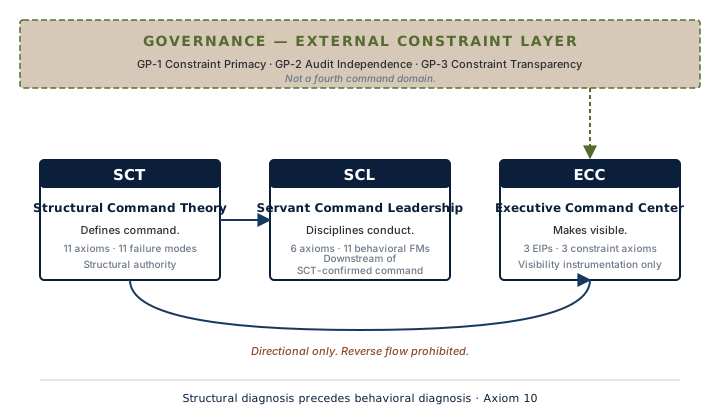
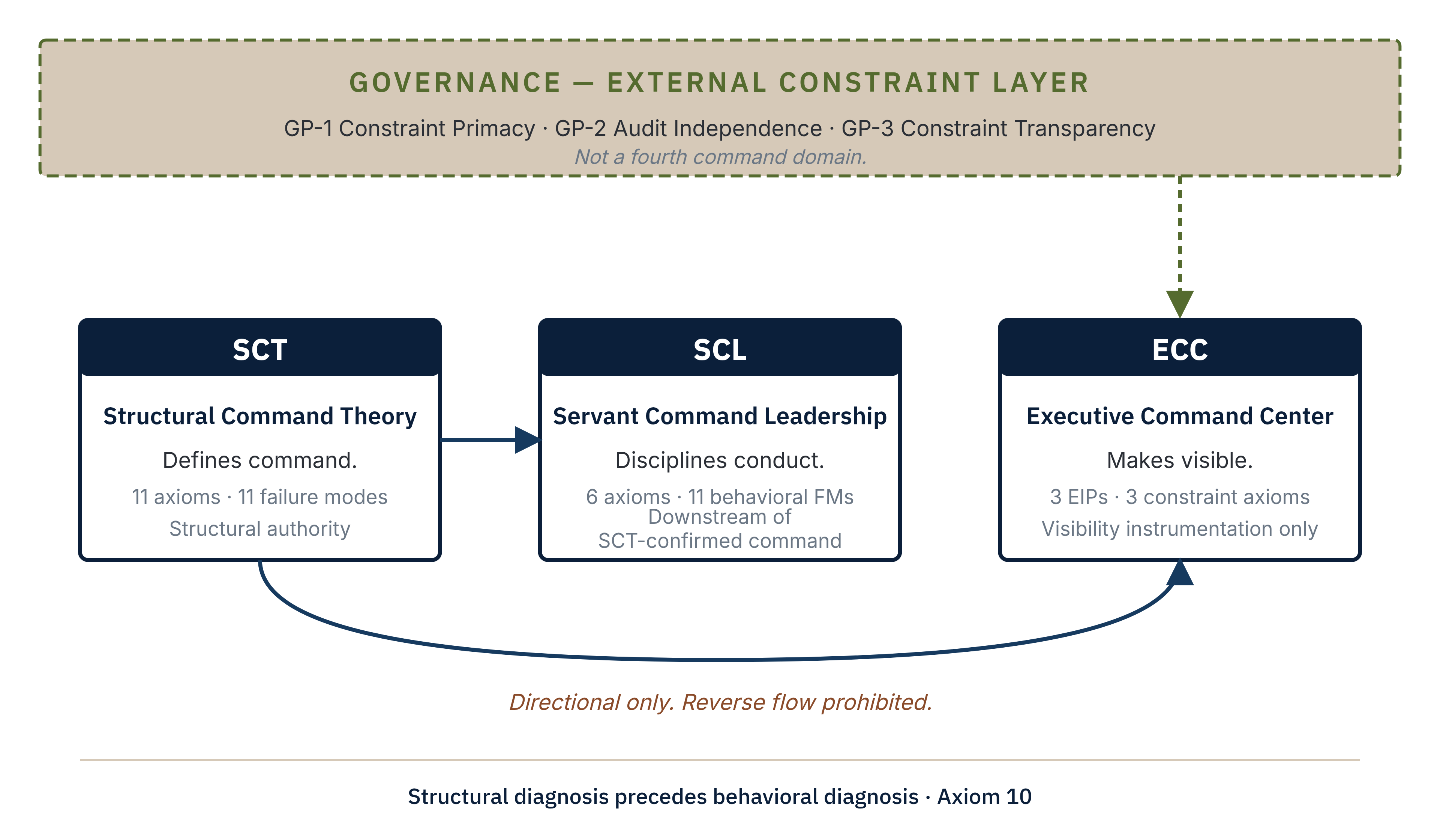
How the three companion specifications — SCT, SCL, ECC — stay categorically distinct. Each occupies its own domain (structure, conduct, visibility); NONCOLLAPSE is the constraint that prevents any one from being collapsed into another.
Framework page, opening section. Goe 2026a §6 for the formal specification.
The NONCOLLAPSE architecture. SCT, SCL, and ECC are categorically distinct command domains. Governance binds them from outside as a constraint layer, not a fourth domain.
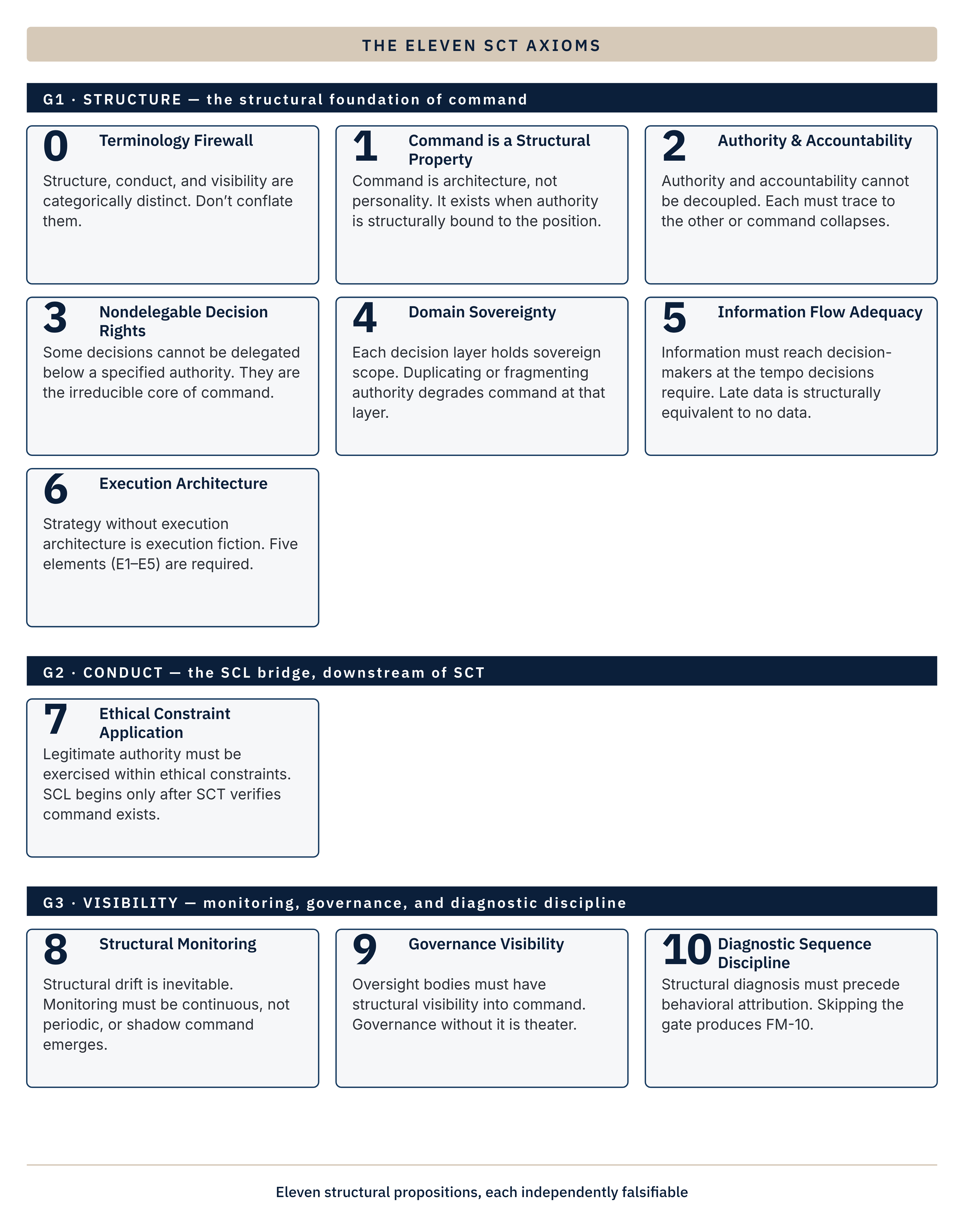
Axioms 0 through 10, grouped by the role each plays in the architecture. Structure (Ax 0–6) establishes the foundation. Conduct (Ax 7) bridges to SCL. Visibility (Ax 8–10) governs monitoring and the diagnostic sequence.
Framework page, axioms section. Goe 2026a §3.2 for the formal specification.
The eleven SCT axioms grouped by role band. Structure (Ax 0–6) establishes the architectural foundation; Conduct (Ax 7) bridges to SCL; Visibility (Ax 8–10) governs monitoring, oversight, and diagnostic sequence.
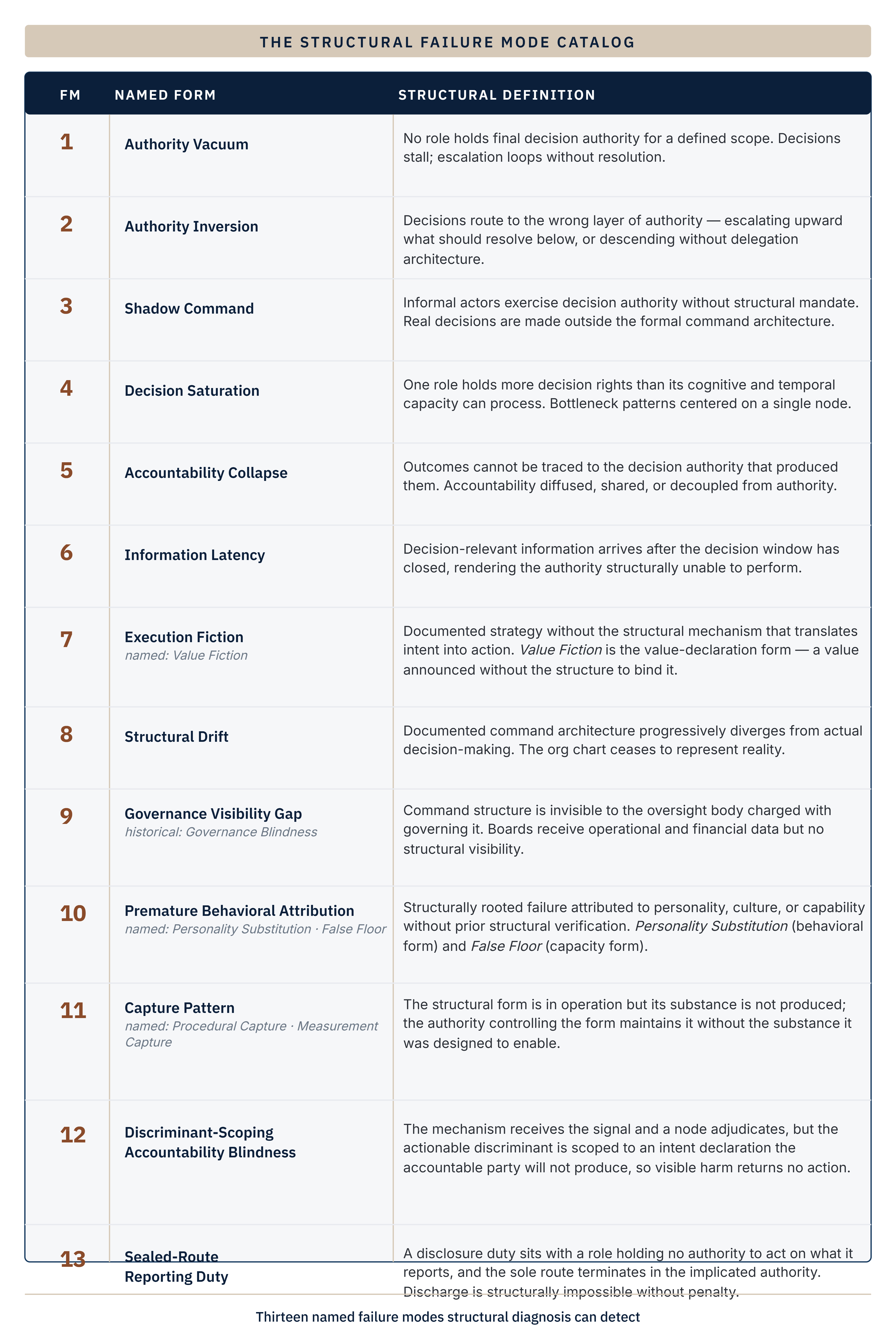
FM-1 through FM-13. The structural failure-mode catalog. Each FM is named, defined, distinguished from adjacent FMs, and anchored to the axiom or constraint it violates.
Framework page, failure-mode catalog. Goe 2026a §7 for the full taxonomy.
The SCT failure-mode catalog runs FM-1 through FM-13. Each is named, defined, anchored to the axiom it violates, and distinguished from adjacent FMs. Named sub-forms (Value Fiction, Personality Substitution, False Floor, Procedural Capture, Measurement Capture) capture the dominant patterns within their parent failure mode. FM-12 and FM-13 postdate the v1.6 working-paper deposit and will appear in the next revision.
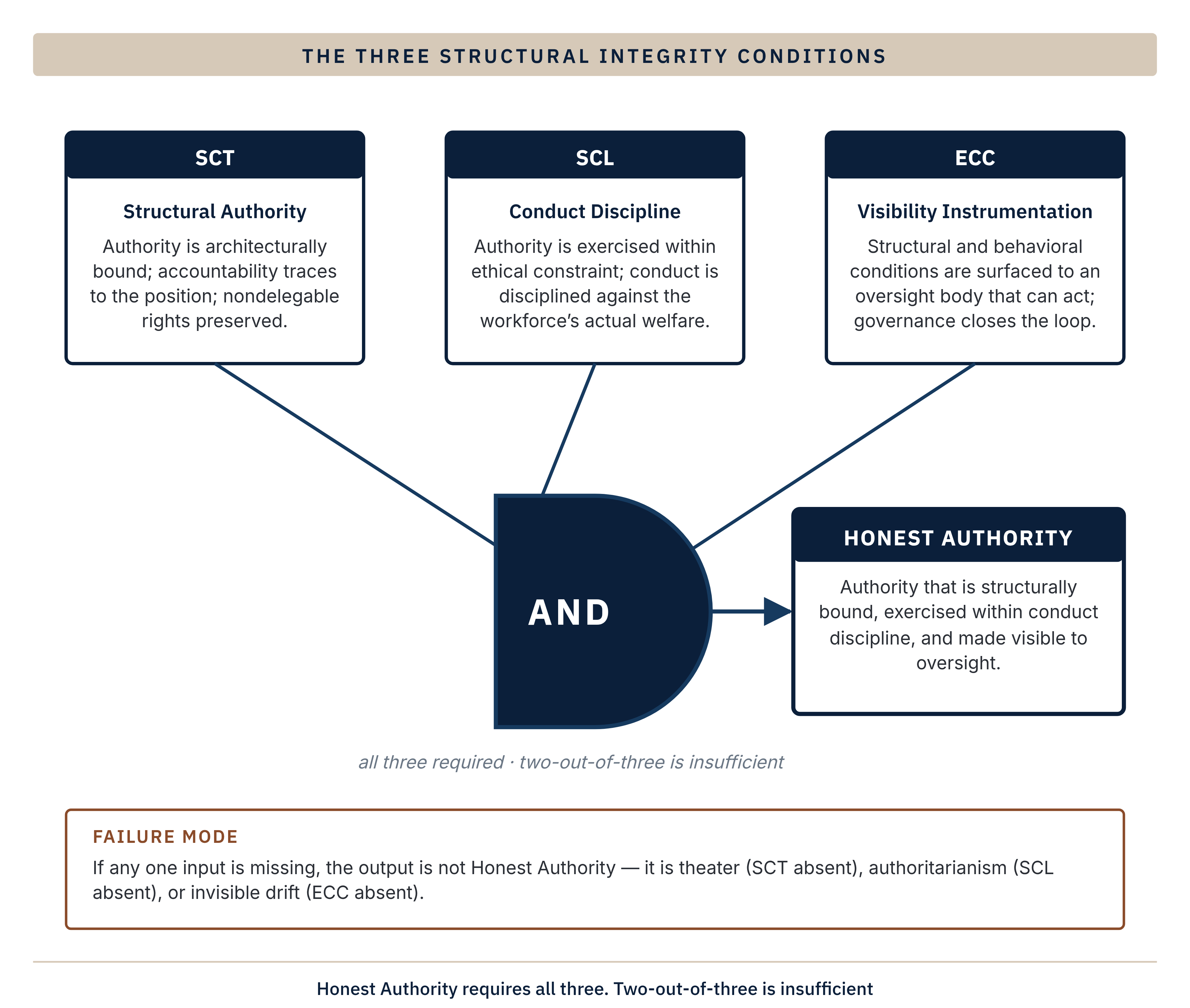
The three conditions Honest Authority requires, joined by an AND-gate: structural authority (SCT), conduct discipline (SCL), and visibility instrumentation (ECC). Distinct from the framework's three structural integrity conditions, which test whether a command node exists at all.
Framework page, integrity discussion. The condition set is referenced across the papers.
The three conditions for Honest Authority operate as an AND-gate. Structural Authority (SCT), Conduct Discipline (SCL), and Visibility Instrumentation (ECC) must all be present. Any one missing collapses the output into a different pathology — not a degraded form of Honest Authority. These are distinct from the framework’s three structural integrity conditions (Authority Specification, Authority Binding, Accountability Loop Closure), which are the test for whether a command node exists at all.
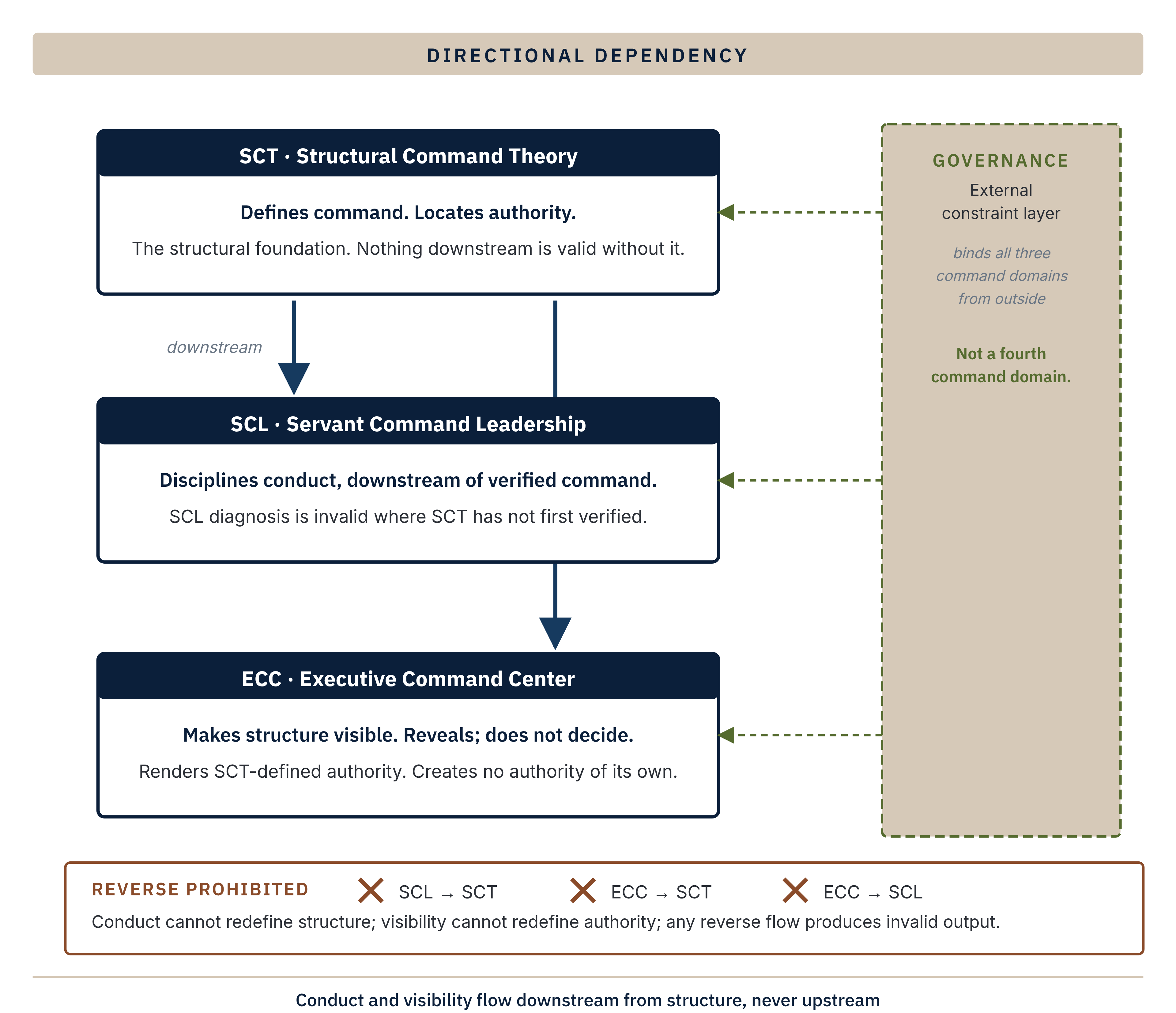
The ordering rule across the three specifications: SCL diagnosis is invalid in organizations where SCT-confirmed command has not first been verified, and ECC instrumentation operates strictly downstream of confirmed command. The arrows show what depends on what.
Framework page, directional-dependency section. Referenced in all three working papers.
The dependency graph is one-way: SCT → SCL and SCT → ECC. Reverse influence is prohibited under all circumstances. Governance binds all three command domains from outside as a constraint layer, but is not itself a command domain.
 Command Analysis Group